Lets start with some recent statistics * In the UK, 460 out of every 500…
25 Mar
Using greater creativity in business analysis and transformation.
Andy McComments off.Too often in the business world of hard-nosed, data-driven and logical analysis, creativity can be left behind. Many see creativity as too unstructured, or “right brained” with a lack of rigor and discipline.
One of the keys to delivering greater success is discovering the way to combine logic, process, structure AND creativity. Well there are in fact many business analysis and ideation tools that facilitate this combination, but one the team here at Conduit Consulting like in particular is the Six Thinking Hats Method, created by Edward de Bono.
WHAT IS CREATIVITY AND WHY IS IT IMPORTANT IN BUSINESS?
Simply put, creativity helps generate fresh, new ideas and innovative solutions for business problems. In this context, creativity is critical. Creativity is in fact a business analysis tool, a business problem solving tool, a business transformation tool and a business strategy tool! But creativity doesn’t come simply by blocking off some time in the calendar and hopping into a meeting room with a whiteboard and some colored markers:
- Being truly creative requires focused attention to get the mind to think differently than it typically does during a normal business day.
- Just trying to be creative isn’t usually very successful either. The mind wants to think the way that it normally thinks.
A creative technique that is familiar to us all is brainstorming, but there are many others. The most powerful creative techniques, used by high impact business advisors utilize deliberate methods to generate different thinking and breakthrough ideas. Proficient practitioners of creativity in the workplace also know how to utilise creative environments and special-purpose events to drive business problem solving, creative solutioning and idea generation. Ultimately, the goal of a good business analyst, management consultant or strategic business advisor is to have a variety of creativity tools and techniques to draw upon. This provides flexibility to pick the approach most suited to the situation and problem being solved.
INTRODUCING THE SIX THINKING HATS METHOD
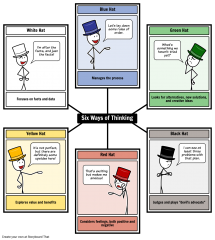
The Six Thinking Hats Method is a powerful business analysis tool for problem solving and idea generation. It is a workshop-oriented method that requires individual participants to think and perform in a certain way (based on the hat they are “wearing”) to help explore issues creatively, objectively and from many pre-defined perspectives. To use the method, colored “thinking” hats are allocated to individuals who are then asked to think about the issue with that specific hat on. The hats are:
- White: Information and data focused;
- Red: Based on feelings, intuition, hunches and emotions;
- Black: Cautious, judgmental, critical;
- Yellow: Optimistic, positive, glass half-full;
- Green: Generator of creative energy, ideas, stimulation;
- Blue: Process-oriented, keeping the creativity moving.
THE SIX THINKING HATS

Using Six Thinking Hats, you and your team will learn how to use a disciplined process which will…
- Maximise productive collaboration and minimize counterproductive interaction/behavior
- Consider issues, problems, decisions, and opportunities systematically
- Use Parallel Thinking as a group or team to generate more, better ideas and solutions
- Make meetings much shorter and more productive
- Reduce conflict among team members or meeting participants
- Stimulate innovation by generating more and better ideas quickly
- Create dynamic, results oriented meetings that make people want to participate
- Go beyond the obvious to discover effective alternate solutions
- Spot opportunities where others see only problems
- Think clearly and objectively
- View problems from new and unusual angles
- Make thorough evaluations
- See all sides of a situation
- Keep egos and “turf protection” in check
- Achieve significant and meaningful results in a less time
The key to this method is the understanding that the process focusses on helping people HOW TO think rather than WHAT TO think.
First note: we have modified the hats by including a seventh or Royal hat. The Royal hat reflects the perspective of the owner who is both committed and invested in the meeting output and project outcome. Use Dr de Bono’s Six Thinking Hats approach to force perspective and capture new ideas:
- You may assign a hat (see perspectives above) to the entire group or a different hat to each person and then rotate the hats to encourage more ideas.
- Use any and all hats as often as you like.
- There is no need to use every hat.
- Provide varying sequences of two, three, four, or more hats at once.
- As session leader (ie, methodologist), you may permit either a pre-set order or one that is evolving. Do not however, facilitate the sequence (ie, facilitating method). Do not ask your participants which hat(s) they would like to wear. They do not know and rely on your expertise for the method.
- You may also use Post-It notes to have participants individually capture a bunch of ideas. As session leader, transpose the notes so that all are legible for the participants, preferably during a quick break.
- You may prefer to not use all the hats, and you may shape the definitions based on your own situation, but use some type of visual prompt to explain the perspectives you are seeking.

Significant Applications for the Parallel Thinking Process of Six Thinking Hats
- Leadership Development
- Team Productivity, Alignment and Communication
- Creative and innovative thinking
- Meeting leadership and decision making
- Product and Process Improvement, and Project Management
- Critical, Analytical Thinking and Problem-Solving
- Organizational Change/Performance
- Wherever High Performance Thinking and Action is needed
WHAT SHOULD YOU WATCH OUT FOR?
Like any business analysis tool or method, Six Thinking Hats has its limitations that need to be considered:
- It can be fun, but sometimes participants can start to think of it too much like a game and it loses the seriousness of the problem or the objective being addressed;
- To use the technique optimally, rotate the hats amongst individuals and resist the urge for any one person to always secure their preferred hat;
- It can take time for an organization’s culture to accept the use of formal creative techniques. Watch out for resistance and perhaps start exploring the use of the tool with smaller, more experimental teams.
WHEN TO USE IT?
The Six Thinking Hats Method can be used regularly and as a one off in challenging situations. A good example of its use in a systematic, regular fashion would be the structured, consistent application of the technique in the early-stages of the product development process. It can also be used within a normal meeting to improve the quality of output. Try asking either the team or an individual to put on one hat at a time and seeing what emerges!
Go ahead, try it out. Watch your business problem solving and business analysis endeavors become more effective when you leverage some structured creativity.
How useful was this post?
Click on a star to rate it!
Average rating / 5. Vote count: